
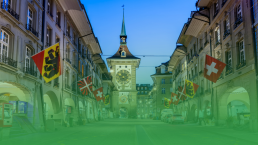
Patching the holes in the EU fabric: a federal Switzerland in a federal Europe
Submitted by Political Commission 3: External Affairs and Global Governance
Re-adopted and amended to its current form by the Federal Committee on April 19, 2026 in Belgrade, Serbia.
JEF Europe,
- Applauding the federalist, multicultural and multilingual democratic system of Switzerland;
- Welcoming the successful conclusion of negotiations on the Bilaterals III package, signed on 2 March 2026 in Brussels by President Guy Parmelin and the Commission President Ursula von der Leyen;
- Recognising the present absence of popular support to join the EU but noting a clear desire to increase collaboration and recognising increased political willingness on both sides to stabilise and deepen relations, as demonstrated by the Bilaterals III package, which includes participation in key EU programmes;
- Deploring the lack of democratic debates before the Swiss government broke off negotiations in May 2021, which created mistrust between the EU and its Swiss partner;
- Welcoming the signature of the EU Programmes Agreement (EUPA) on 10 November 2025, granting Switzerland association to Horizon Europe, Euratom, and Digital Europe retroactively from 1 January 2025, with participation in ITER from 2026, EU4Health (subject to the health agreement), and Erasmus+ from 2027;
- Regretting the slow unravelling of bilateral agreements due to the lack of progress in their update which led, among other things, to the loss of the stock exchange equivalency, and non-renewal of the Mutual Recognition Agreement (MRA) provisions on medical devices (aka MedTech), impacting Swiss companies and customers with rising prices and/or less choice of products and services, and acknowledging that the Bilaterals III package addresses these issues through updated agreements on air transport, land transport, free movement of persons, conformity assessment, and agricultural products, complemented by new agreements on food safety, health, and electricity;
- Acknowledging the Swiss semi-direct democracy system which has worked well for Switzerland, and noting that, when Switzerland becomes an EU member, Swiss referenda would become an integral part of the EU decision-making process in all domains where Swiss parliamentary authorities are engaged, exclusively or jointly as part of EU decision-making, but not when competencies are exclusive to the EU, in line with the Swiss federalist logic between municipalities, cantons, and the Confederation;
- Acknowledging the recommendations issued by the Council of Europe’s Group of States against Corruption (GRECO) to Switzerland regarding political funding for elections, referenda and initiatives;
- Deploring the structural democratic deficit inherent in the bilateral model, whereby Swiss lawmakers incorporate EU law into Swiss law without having formal representation in EU decision-making institutions, a gap that can only be fully addressed through Swiss EU membership or through new institutional arrangements that have not yet been developed on either side;
- Highlighting the importance of the continuation of cross-border cooperation between Switzerland and its neighbours at the local and regional level, including but not limited to key areas such as public transport, scientific research, education, healthcare, environmental conservation, and economic development;
- Recognising the prevalence of cross-border workers in the Swiss labour force, constituting a significant proportion, who engage in commuting activities from neighbouring countries, thereby rendering them notably susceptible to challenges associated with cross-border work-related impediments;
- Mindful of fears over maintaining high wage levels in Switzerland in the face of EU integration, but aware that the cases of Denmark, Luxembourg and others have shown that maintaining high wages is compatible with EU membership;
- Concerned that EU law may be applied differently in Switzerland and that there may be a lack of an efficient dispute resolution mechanism between Switzerland and the EU; an issue addressed in the Bilaterals III package through provisions for dynamic alignment of legislation and a dispute-settlement mechanism;
- Noting that the safeguard clause on free movement of persons has been modified: Switzerland can maintain the clause but can no longer activate it unilaterally without prior discussion with the EU;
- Welcoming Switzerland’s participation in most EU sanctions packages, and noting that the Swiss Parliament has approved amendments to the War Material Act allowing automatic re-export of weapons to 25 countries that share Swiss values and have comparable export control regimes, subject to a possible referendum and with the government retaining the right to block individual exports on national security grounds, while regretting that this change is not retroactive and therefore does not affect Swiss made weaponry bought by EU states prior to its entry into force, and noting with concern that Ukraine is not included among the benefiting countries;
- Respecting Swiss military neutrality, but also reminding Switzerland that it benefits disproportionately from the EU’s security and defence mechanisms without contributing, and that there will be growing expectations from the EU and its Member States for Switzerland to contribute to Europe’s future security and defence architecture and to level the playing field in security and defence spending;
- Calling on the EU to remain responsive to Switzerland’s security concerns and to engage in genuine partnership, recognising that a stable and mutually beneficial relationship requires efforts from both sides;
- Welcoming Switzerland’s commitment under Bilaterals III to a permanent financial contribution to EU cohesion: CHF 130 million annually for 2025-2029, increasing to CHF 350 million annually for 2030-2036;
- Noting the establishment of a high-level dialogue between Switzerland and the EU through a joint declaration, providing for annual meetings to review progress and discuss future cooperation;
- Welcoming the new agreements on electricity, food safety, health, and Switzerland’s participation in the EU Agency for the Space Programme (Galileo and EGNOS), which deepen sectoral integration beyond the internal market;
- Welcoming progress toward an EU–Switzerland electricity agreement, recognising Switzerland’s strategic importance in European energy security and the shared goal of a carbon-neutral continent.
JEF Europe therefore,
- Urges Switzerland to join the EU in order to fill the current democratic gap and enjoy the benefits of EU membership;
- Encourages Switzerland to pursue the process of European integration and to ensure the successful ratification of the Bilaterals III package through its parliamentary and popular consultation processes;
- Suggests that Switzerland join Liechtenstein, Iceland and Norway in the EEA in the short term as a possible first step toward EU membership, while acknowledging that the Bilaterals III package already provides access to key EEA programmes including Horizon Europe, Erasmus+, Digital Europe, and Euratom, and recognizing that this step could be skipped by directly applying for EU membership, which remains the desired end goal;
- Calls on Switzerland to join the ERM II mechanism following accession and to adopt the euro once the convergence criteria have been met;
- Calls on the EU and Switzerland to conclude an energy agreement as part of a comprehensive package; welcoming that such an agreement on electricity is included in Bilaterals III;
- Invites Switzerland to modernize its interpretation of neutrality and align fully with the foreign policy of the EU in particular as regards to sanctions and sanction enforcement against Russia in response to the full-scale invasion of Ukraine, welcomes the Swiss parliament’s approval of amendments to the War Materiel Act easing weapons re-export restrictions to 25 countries sharing Swiss values, while regretting that Ukraine is not included and that the changes are not retroactive;
- Recommends that special attention be given to potential issues arising from Switzerland’s high wage and price levels by replacing current “accompanying measures” by EU and / or Swiss legislative measures designed to protect local wages;
- Commits itself to support a referendum or a citizen initiative in Switzerland aiming at closer integration of Switzerland with the EU;
- Urges Switzerland to become a participating country of the Erasmus+ programme, welcoming that participation is confirmed from 2027 under Bilaterals III;
- Strongly calls for full and permanent re-association of Switzerland to EU research programmes and Erasmus+ beyond the current Bilaterals III timeline, ensuring long-term stability for Swiss and European students, researchers, and innovators;
- Commits itself to support JEF Switzerland in its objectives of improving the relationship between Switzerland and the EU and to support Switzerland in becoming a full member of a federal European Union.
First adopted by the Federal Committee on 11 November 2023 in Madrid, Spain. Re-adopted and amended to its current form by the Federal Committee on April 19, 2026 in Belgrade, Serbia.