
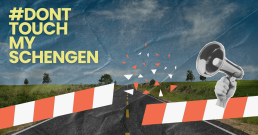
Every day, more than 400 million Europeans benefit from one of the EU’s greatest achievements: the freedom to cross borders without being controlled. It allows workers to commute across borders, families to stay connected, and businesses to thrive in integrated border regions. Yet this freedom can no longer be taken for granted. Across Europe, and especially since 2026, governments are prolonging internal border controls, turning exceptional measures into a dangerous new normal.
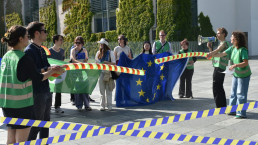
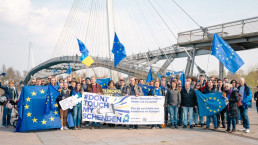
With our #DontTouchMySchengen campaign, JEF Europe is standing up for a border-free Europe, defending the right to free movement, and protecting the Schengen Area as one of the strongest symbols of European unity. Forty years after the Schengen Agreement was signed, we refuse to let one of Europe’s greatest success stories be dismantled piece by piece.
What is Schengen?
- The Schengen Agreement is a treaty between European countries that led to the abolition of systematic border checks at the internal borders between participating states. Today, it forms part of the European Union’s legal framework, although not all signatories are EU member states. This is why we speak of the “Schengen Area”: 25 EU Member States and 4 non-EU countries (Iceland, Norway, Switzerland and Liechtenstein).
- The original Schengen Agreement was signed in 1985 by the governments of the BeNeLux countries, Germany and France. It was complemented by the Schengen Implementation Convention in 1990 and further expanded as more countries joined.
- Schengen stands for the freedom to travel, live, and work across Europe without routine passport checks or systematic customs controls at internal borders. It is one of the most tangible achievements of European integration, making everyday cross-border life possible for millions of Europeans.
Despite the clear rules of the Schengen Borders Code, an increasing number of member states—including Germany—are introducing measures that violate EU law. The supposedly temporary reintroduction of internal border controls, justified by security concerns or migration, has become disproportionate and unlawful. By defending these measures in the name of law and order, governments are ultimately undermining the credibility of the rule of law itself.
What are the impacts
These controls are a massive disruption, not only on the ideal level, but also in terms of economics and relations between the countries concerned. As a study commissioned by the European Parliament back in 2016 revealed, especially on the economic side the costs of prolonged border controls has been calculated as high as €5 billion for a two year suspension concerning seven countries and up to €51 billion for the entire area. [1] One sector that had profited especially from Schengen, the transportation sector would be heavily damaged, not only in the monetary dimensions (€300 billion considering the waiting time at the border) but also in the social ones; disruption of health services in Luxembourg during Covid crisis and the everyday cross-border working people. These often unilateral decisions of countries, especially Germany to extend their border controls, poisons the relationship between the neighbors. Poland voiced on multiple occasions its discontent with these measures, as have others such as Luxembourg. [2] It is a poison to European unity and only helps to make these controls the new status quo in the public.
Controls are just the tip of the iceberg
While border controls are a very visible barrier to free movement, there are many other – much more subtle – bumps on the road. From poor transport planning failing to fulfil the mobility needs of cross-border commuters, to vetoes massively delaying Schengen enlargement or restrictive legislation in multiple areas that curtail the rights of specific categories of people when it comes to their right to freely roam the Schengen Area.
How can you help?
There are several means through which you can make your voice heard. Contact your national and European MPs, get their position on the matter and advocate for the rollback of the border controls and for effective measures to make freedom of movement a true reality, connect with other organisations. Also join our campaign and our larger network so that we can represent a strong voice on the national and European level.
Read our manifesto here!
Further reads
Don't Touch My Schengen 2016
Free movement of people is one of the cornerstones of the European Union. Open borders are one of Europe’s greatest milestones. Unfortunately it seems that European countries are taking steps back to 28 separate border policies.
On the 6th of February 2016, all over Europe, the Young European Federalists have created a massive online campaign #DontTouchMySchengen with a massive social media response.
If you’re interested in our 5 Proposals as the outcome of this campaign, please read them here.
Young European Federalists want to keep the borders open and call for one border policy to protect the external borders of the EU. Do you agree? Then join #DontTouchMySchengen.