
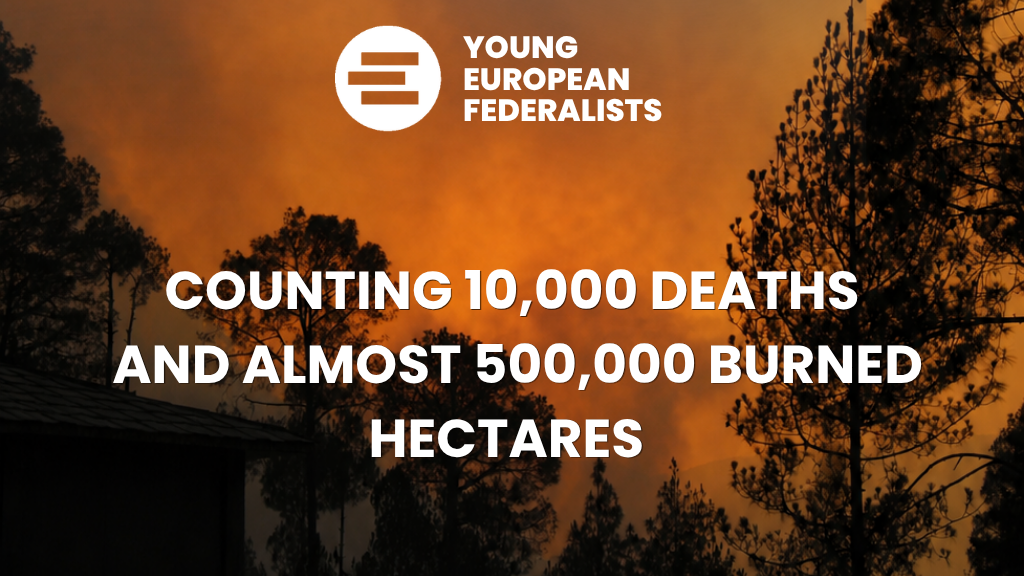
JEF Europe urges the EU to fund fire prevention and heat adaptation
Since the beginning of summer, Europe has been facing an unprecedented series of heat waves deeply impacting the daily lives of all Europeans as well as our ecosystems and agriculture.
JEF Europe notices the failure of our governments to reverse the climate crisis. We demand more actions on the front of climate change mitigation, most notably through cuts on greenhouse gas emissions. At the same time, we need climate adaptation measures to protect the most vulnerable groups who are suffering the most.
We call on the European Union, its Member States, regions and enlargement candidates to apply concrete measures to prepare our continent to face the next decades and the second half of our century to climate deregulation, from mandatory heat protection for the most vulnerable, to binding safety standards at work, to a continent-wide capacity to prevent and fight wildfires.
According to EuroMOMO, more than 10,000 excess deaths were recorded in the late-June heatwave in Europe, over 9,000 of them people aged 65 and over. France alone recorded at least 5,764 excess deaths in that period. This vulnerability gap is already visible in Europe’s care homes. Fewer than 10% of rooms in French residential care homes for older people are currently cooled, a share that has barely moved since 2020, even as 85% of the deaths in this June’s heatwave were people aged 65 and over. JEF Europe insists that heat adaptation, including cooling, shading and monitoring, become mandatory in schools, hospitals and elderly-care facilities, the institutions housing the people most at risk. Hospital air conditioning alone could cut heatwave mortality by an estimated 40%, and that gap is too costly to leave to national discretion. JEF Europe urges the EU to set binding deadlines for cooling in care homes and hospitals within the next decade, and in schools within a generation, backed by early-warning protocols that activate ahead of a heatwave, taking into account nature-based and low-tech solutions.
Heatwaves have also turned workplaces across Europe into a hazard: one in five EU workers now reports exposure to extreme heat on the job, and unions estimate 230 heat-related worker deaths and 277,000 injuries a year among the 130 million workers exposed. JEF Europe rejects the idea that worker safety should depend on which EU country someone happens to work in. Italy and Greece already suspend outdoor work during the hottest hours on high-risk days, roughly midday to late afternoon, and JEF Europe backs the European Trade Union Confederation’s call for a binding EU-wide maximum working temperature, paid cooling breaks, and guaranteed access to water, shade and protective equipment. JEF Europe further pushes for climate leave and flexible or remote-work arrangements during extreme-heat episodes, which strengthen these protections but cannot replace binding rules on temperature limits and rest breaks.
But it is not only people who are exposed. The land that feeds Europe is just as unprotected, and climate experts warn that Europe has reached the expected extreme temperatures for 2050 decades before models predicted. Over the past weeks, severe wildfires have been multiplying across the rural areas of southern Europe, in France, Spain, Italy and Greece. Industry forecasts put the total European grain harvest down 9 to 10 million tonnes because of the June heatwave. The heatwave also hit other farming sectors, with hundreds of thousands of chickens dying in France and Greece from extreme heat and vegetable crops damaged by soil moisture loss.
Our continent needs to prepare itself to face the multiplying wildfires. Currently, local and regional authorities remain responsible for delivering most adaptation measures while their resources are limited. The EU should thrive to establish a ring-fenced, multi-year firefighting and prevention budget within the Multiannual Financial Framework. Besides this effort, Member States should improve their cross-border resource pooling through investments at national, regional and local levels to ensure a resilience of the rescue system.
The public effort must also be supported by foresters and farmers through fuel-reduction practices by supporting the creation of fire breaks or pastoralism for instance. Financial incentives under the Common Agricultural Policy (CAP) could be topped up for fire prevention measures, in the spirit of supporting farmers for the environmental services they provide. While farmers have to play an active role against wildfires, their losses must also be fairly compensated by natural disaster funds when private insurance coverage fails. This is especially important for young farmers and new entrants since fewer than 12% of EU farms are managed by farmers under 40, and this ageing of the agricultural sector weakens Europe’s capacity for the land management practices that wildfire prevention depends on. Fire-prevention land stewardship could become a viable entry pathway into farming for the next generation through a public-private resilience mechanism. In doing so, the EU and its member states must fully adhere to the goals set out in the nature restoration regulation, to make various ecosystems future-proof.
From hospital wards to burning hillsides, the pattern is the same: Europe reacts once the damage is already done, but we cannot afford the inaction anymore. We call the European Commission in the preparation of its Climate Resilience strategy to move beyond voluntarism and set the priorities to binding structural standards.
This statement is based on the following JEF Europe resolutions:
- A Federal Strategy for Agriculture to provide sustainable, safe and healthy Food for all Europeans
- Environment does not stop at Borders: Towards a sustainable Europe and a sustainable global Climate Policy
Further inquiries:
- Vice-President responsible of climate and social policy portfolios, Nea-Maria Törmänen, nea-maria.tormanen@jef.eu
- Treasurer responsible of rural areas, agriculture and cohesion portfolios, Anna van de Moosdijk, anna.vandemoosdijk@jef.eu