
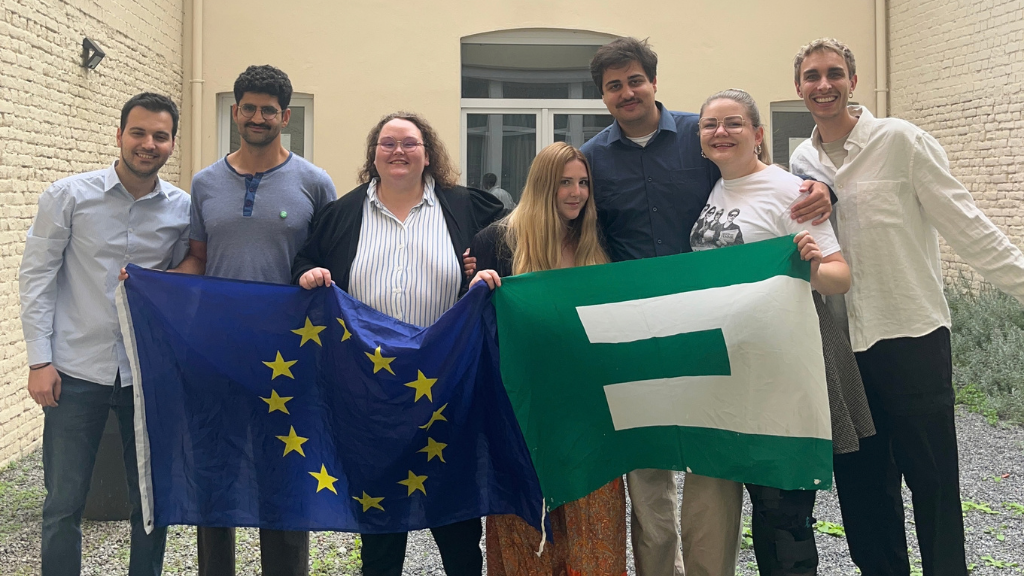
JEF Executive Board Sets Course for Resilient Federalist Action
Brussels, 26–28 September 2026 | The Executive Board of JEF Europe gathered in Brussels for a weekend of strategic discussions, campaign planning and organisational development.
The meeting provided an opportunity to reflect on the Executive Board’s mandate so far, improve internal working methods and strengthen collaboration with the European Secretariat. Discussions on statutory reform, project applications and the planning of political campaigns formed part of this effort to make JEF a stronger and more resilient movement.
One Federalist Movement: Strengthening Cooperation with UEF
The meeting also marked an important milestone in cooperation between generations of European federalists, with a joint meeting of the Executive Boards of JEF Europe and the Union of European Federalists (UEF) at the European Parliament. On 28 September, MEP Markus Ferber hosted us at the European Parliament. The Presidents of both organisations, Moritz Hergl and Domènec Ruiz Devesa, chaired the meeting and underlined the importance of closer cooperation between JEF and UEF, building on the joint declaration.
Among the concrete areas of cooperation discussed were closer coordination between political commissions, joint coordinated transpartisan campaigning for the upcoming elections in 2027 in the member sections, fundraising efforts, as well as the planning for the March 4 Europe.
March for Europe 2027: Mobilising for a Federal Europe
One of the central priorities emerging from the discussions was the March for Europe, planned for 20 March 2027 in Rome, marking the 70th anniversary of the Treaties of Rome. Together with UEF, the European Movement and other civil society partners, JEF Europe is preparing to mobilise citizens from across the continent in support of a stronger, more democratic and united Europe. On the same weekend, JEF Europe’s Federal Committee will take place in Rome, enabling young federalists from across Europe to participate.
The March for Europe is intended to send a clear political message: Europe needs a new phase of integration, including institutional reforms that allow the Union to meet the challenges of our time. Preparations will include joint communications, outreach to civil society and political partners, and mobilisation through national and local sections.
National Elections Are European Elections
Another important outcome was the agreement between JEF and UEF to develop a joint campaign around the national elections taking place across Europe in 2027. Although citizens vote in national elections, their outcomes increasingly determine Europe’s collective future. Decisions on European defence, enlargement, the EU budget and institutional reform are shaped by national governments and political majorities. Yet these European questions often remain absent from national electoral debates.
The campaign will also serve as a stepping stone towards the 2029 European elections, helping build stronger federalist networks and a more genuinely European political debate.
Building a Stronger and More Resilient JEF
Alongside political discussions, the Brussels weekend was dedicated to strengthening JEF Europe’s internal capacities in times where funding for civil society is becoming increasingly competitive. We reflected on our working methods, organisational priorities and the challenges of sustaining a volunteer-driven European youth movement. We also gathered some input for the process of our statutory reform, for the improvement of project applications, and planned the upcoming FC in Athens.
If you have questions or input for the Executive Board, do not hesitate to reach out to Moritz Hergl.