In Europe, we need the power to decide, the resources to act, and democratic institutions accountable to European citizens.
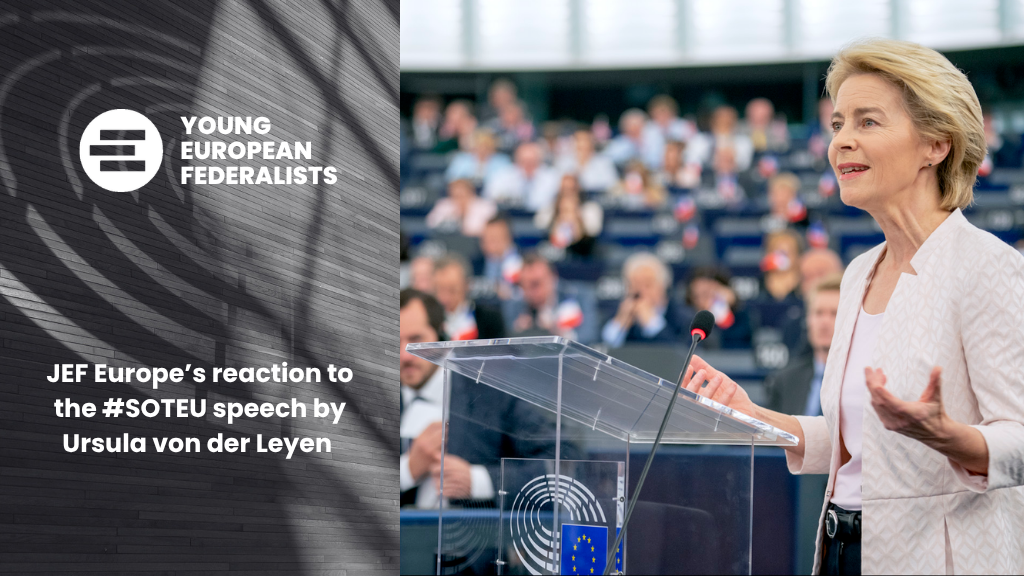
In her annual State of the Union address, Commission President Ursula von der Leyen laid out her political vision for the next year: “Only Europe can provide true sovereignty to Europeans”, was one of her core messages that we strongly support. As Federalists, we are convinced: Effective sovereignty can no longer be exercised exclusively at national level.
In many policy areas, from defence to energy, and AI, Member States increasingly lack the scale required to act autonomously. The gap between national sovereignty and effective European capacity is widening. Many of von der Leyen’s assessments are correct: We are not speedy enough and Europe is lacking in investments, we are heavily dependent on China and others economically. Meanwhile, the rules-based system is eroding. We support the approach to build global coalitions with like-minded partners on the basis of our values. Therefore, the commitment to the Canada-EU strategic partnership is the correct path.
Associate membership for Canada, as vague as the concept may legally be, is a clear commitment to liberal democracy and can concretely help to overcome challenges in Arctic security, and economic development. We support this strategic shift. But a commitment to Canada on “associate membership” cannot go independently from the formalised enlargement process, where European countries have been in the waiting line for decades.
Von der Leyen focussed on the topic of democratic resilience and the last elections in Hungary were indeed a beacon of hope in this regard. She did well in pointing out this important success for Europe as a whole. But the underlying problem remains the institutional lock-ins that open an easy door for autocrats and dictators. The Orban regime held Europe hostage on the question of support to Ukraine – and to overcome these institutional shortcomings, we need more than the announcement of a new “European Congress”. What we demand is a clear path forward on how we can change our treaties, and give European sovereignty a chance.
That being said, we welcome the announcement of a European Security Council, the only concrete mention of an institutional reform in von der Leyen’s speech. How this will be implemented, and how supranational this body can act depends on us. A European Security Council can only be a step forward if it strengthens European decision-making rather than creating another forum for national vetoes. It must be embedded in the Union’s democratic institutional order, accountable to the European Parliament and capable of taking decisions in the European interest.
But being serious about European sovereignty also means putting the money where the mouth is. We are glad that the need for Own Resources for the next Multiannual Financial Framework were put so clearly in the speech. They are indeed the only way forward, to be able to repay joint debts, to lighten the load of member states, and to finance European joint action. But Von der Leyen did not lose any more words on the budget, yet this is the clear question that will decide whether Europe will be a capable actor in its own right in the next years.
Von der Leyen put climate adaptation at the centre of her speech. She announced a European heatwave plan and a strategy to deal with water scarcity. She also connected it to the societal question of intergenerational fairness and presented a European Care Deal. We welcome these initiatives, but warn that the words need to be filled with actions. Mere announcements of new summits are not going to cut it! Meanwhile, her announcements on legislation to “protect” young people online was spelled out in detail. We warn that such policies affecting our entire generation cannot be designed without us. Young people must be treated as citizens with rights and agency, not merely as users to be protected.
Europe is a peace project and remains so. But so far, Europe was not able to put a fair end to Russia’s war of aggression on Ukraine. Von der Leyen pledged the “strongest-ever support to Ukraine over the toughest winter of the war” and we ask for accountability of this promise. But supporting Ukraine will also mean that the European Defence Union must be established: This requires a European chain of command, parliamentary scrutiny at European level, clearly identifiable political responsibility, and democratic authority capable of acting in the name of European citizens. This question of European political authority remains underdeveloped. While building common military capabilities, four questions become unavoidable: Who decides, who commands, who finances, and who is democratically accountable?
Her nod to Israel and Palestine and the need for an equal right to live in safety and with dignity was correct. But it sounds unserious looking at the scope of inaction towards the Netanyahu government over the last year. Keeping the flame of a two-state solution alive is not enough, we must promote a Federal Future for Israel-Palestine. Beyond humanitarian help, this means supporting democratic political forces on both sides to work towards coexistence and shared institutions.
Von der Leyen called to win back the hearts of Europeans. 70 years after the signing of the Rome Treaties it must be the role of us federalists to live Europe with our hearts. This does not only require ambition in various policy fields, ranging from defence to climate to AI. This requires us to reform the way we take decisions by at the same time ensuring genuine risk sharing, and the way we finance our Union.
Acting European means new competences for the EU, more subsidiarity and more direct citizen participation. With own resources and a genuine common fiscal capacity, rather than permanent dependence on national budgets, we can unlock this ambition!
The EU is still loading. It is time to install the updates.
Media contact:
Moritz Hergl
President of JEF Europe
president@jef.eu
+4915733919942