
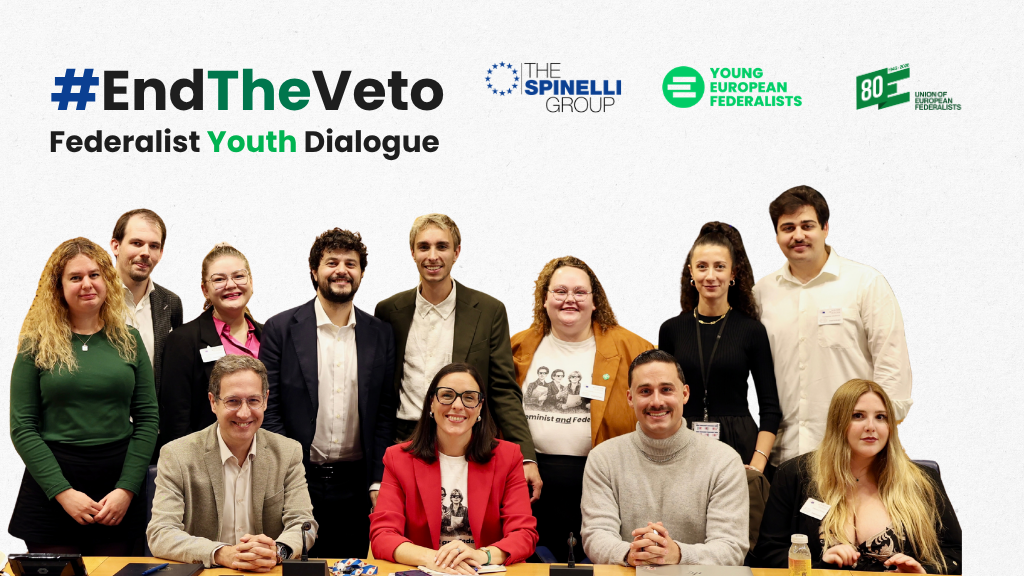
#EndTheVeto: Building a Political Majority for a Europe That Can Act
How can Europe overcome the veto and build political majorities for reform? On 29 September, JEF Europe, the Spinelli Group and the Union of European Federalists brought Members of the European Parliament, young federalists and representatives of European political youth organisations together at the European Parliament in Brussels to discuss exactly this question.
The starting point of the #EndTheVeto: Federalist Youth Dialogue was clear: Europe’s geopolitical reality has changed dramatically, but many of the rules through which the EU takes decisions have not: From Russia’s war against Ukraine and growing geopolitical competition to enlargement, climate change and economic security, Europeans increasingly expect the EU to act. Yet in crucial policy areas, a single national government can still block common European decisions.
As Raquel García Hermida-van der Walle MEP, President of the Spinelli Group, put it:
“Five years ago, we as federalists were almost dismissed as crazy. Now everyone is coming on board, if not out of conviction, out of necessity.”
Towards a Europe that can decide
The discussion showed that ending unanimity is no longer only an institutional debate among federalists. It increasingly concerns a fundamental question of European democracy: Can Europeans collectively take decisions on the challenges that affect them?
Opening the event, JEF Europe President Moritz Hergl argued that a European federation must ultimately mean creating a common European political space. Today, European politics is still largely fragmented into national debates.
“We have German debates, we have Dutch debates, we have Spanish debates. And they don’t really match,” he argued. As long as European political debates remain predominantly national, the veto can appear to be a safeguard of national political identity rather than an obstacle to common democratic decision-making. This also means that the debate about institutional reform cannot remain a technical discussion about Treaty articles. The consequences of unanimity have to become tangible.
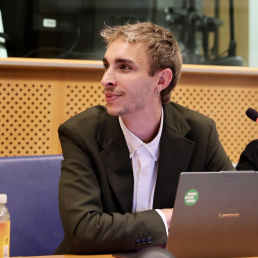
Russia provides one particularly visible example. When Viktor Orbán uses Hungary’s veto power to obstruct common European positions on Ukraine or Russia, an institutional problem suddenly becomes politically understandable. “Putin was sitting at the table of the European Council with the face of Orbán”, Moritz summarised.
There is more than one way to overcome the veto
Participants discussed a wide range of possible strategies. Treaty reform remains essential for creating a democratic and federal Europe, but waiting for one comprehensive Treaty revision cannot be the only strategy. Existing passerelle clauses could move additional decisions from unanimity to qualified-majority voting. Constructive abstention and enhanced cooperation could allow willing Member States to move forward.
One new example is the idea of replacing the individual national veto with a collective or “pooled” veto, meaning that several Member States would be needed to block a European decision. Another proposal discussed was linking changes to veto rights to future EU accessions. Ultimately, we must build political momentum through multiple avenues simultaneously. As Marten Porte, President of LYMEC put it: “Just waiting for one Treaty change to solve our problems is probably not going to do the trick.”
Parliament must use the power it already has
A recurring message from the Members of the European Parliament was that European institutions themselves need to become more assertive. Domènec Ruiz Devesa, President of the Union of European Federalists, highlighted the possibilities already available to move away from unanimity and stressed the need for political pressure on Member States. Brando Benifei MEP, meanwhile, called for the European Parliament to make much stronger use of its existing powers, particularly its budgetary authority. This becomes particularly relevant in the discussion about the EU’s next Multiannual Financial Framework. Several participants questioned whether governments can simultaneously demand stronger European action on defence, competitiveness, climate and security while refusing to provide the Union with sufficient common resources.
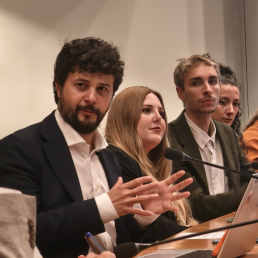
Benifei criticised the growing gap between pro-European rhetoric and concrete political decisions:
“When it’s nice to say, they say they want a united Europe, they even say they want a federal Europe. Then, when we have to look at how we build the budget, they want to cut the budget.”
For federalists, the conclusion is clear: European sovereignty requires European capacity. Changing voting rules without giving the European level the resources necessary to implement common decisions will not be enough.
Building a culture of federalism
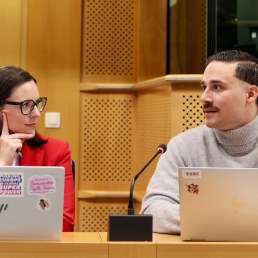
Lukas Sieper MEP emphasised that change can also happen gradually by building a political culture in which common European decision-making becomes normal. Federalists, he argued, should not become too concerned about whether politicians arrive at European integration because of ideological conviction or political necessity:
“We should not really care so much about the motivation as federalists. We should care about the conviction for the goal.”
Using existing mechanisms such as enhanced cooperation, constructive abstention and stronger European democratic instruments can gradually make European-level decision-making more tangible. He also called for stronger instruments of European citizenship and participation. The current ECI needs an update, he argues. The same also applies to young people and their involvement: consultations alone cannot become a substitute for political power.
Federalism needs to leave the federalist bubble
One of the clearest strategic conclusions from the dialogue was that federalists cannot achieve institutional reform by speaking only to people who already agree with them.
“Don’t spend your time just preaching to the convinced,” Lukas Sieper warned.
That means finding new political narratives and new allies. One potential bridge for this is subsidiarity, a fundamentally federalist principle. Decisions should indeed be taken as close to citizens as possible — but at a level capable of actually addressing the problem. Federalism therefore does not mean centralising every decision in Brussels. It means exercising democratic power at the appropriate level: locally where possible, nationally where appropriate, and European where necessary.
Europe should transform, not merely preserve
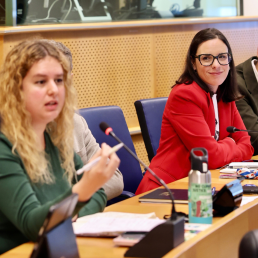
Cinta González Sentís, Secretary General of the Federation of Young European Greens, introduced another important dimension to the debate: defending European integration cannot simply mean defending the status quo.
“Europe is not here to preserve something, but should be here to transform something.”
For young people experiencing housing insecurity, precarious employment, climate change or inequality, preserving today’s Europe is not necessarily an inspiring political project. Instead, institutional reform must answer a more fundamental question: What do we want European power for?
A Europe capable of transforming its energy infrastructure, protecting biodiversity, strengthening democracy, reducing dependencies and providing social security requires institutions capable of taking and implementing decisions. This also means expanding the understanding of European democracy beyond elections. Trade unions, student organisations, civil society, climate activists and youth organisations all provide spaces through which Europeans organise and exercise democratic power.
Enlargement makes reform more urgent
EU enlargement also adds to the debate on reforms. Konstantine Gagnidze, Board Member of JEF Europe, spoke from the perspective of young Europeans in Georgia and Ukraine. While Euroscepticism is increasing within parts of the EU, people in candidate countries continue to struggle — and in Ukraine, sacrifice their lives — for a European future. He highlighted the urgency of building a Union capable not only of enlarging but of acting.
An EU designed initially for six Member States has already expanded to 27 and could grow further. Enlargement without institutional reform risks increasing paralysis. But delaying enlargement indefinitely until every internal institutional question has been resolved would leave candidate countries exposed to geopolitical pressure.
For JEF Europe, deepening and widening therefore cannot be alternatives: they must reinforce each other.
The cost of non-Europe is already being paid
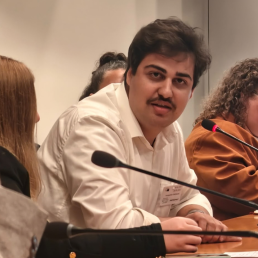
JEF Europe Treasurer Anna van de Moosdijk brought the institutional discussion back to people’s everyday lives through the example of climate change. Europe needs investment in climate adaptation, resilient infrastructure and mitigation. Refusing to create sufficient European financial capacity does not make those costs disappear. “We are going to pay the price of it anyway,” she stressed.
Finally, Vice-President Debora Striani concluded that the debate currently is also about subsidiarity: Everyone acknowledges the need to do politics as close to citizens as possible, however today’s problems are of such a scale that for most the European level is the most effective. As federalists, our task is to promote these European opportunities.
From dialogue to political majorities
The Federalist Youth Dialogue was deliberately designed not to end inside the European Parliament. Representatives of European political youth organisations joined the discussion to explore how institutional reform can gain support across political families. The official programme brought together representatives from the Young European Socialists, LYMEC, FYEG and European Democrat Students alongside JEF Europe, MEPs, the Spinelli Group and UEF. JEF Europe will continue to expand the coalition around #EndTheVeto.
Ending the veto is not the end goal. It is a step towards a Europe in which Europeans can decide and act together.